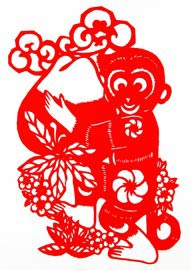
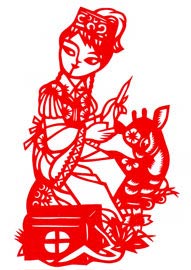
Paper-cut is a very distinctive visual art of Chinese handicrafts. It
originated from the 6th century when women used to paste golden and
silver foil cuttings onto their hair at the temples, and men used them
in sacred rituals. Later, they were used during festivals to decorate
gates and windows. After hundreds of years' development, now they have
become a very popular means of decoration among country folk, especially
women.
The main cutting tools are simple: paper and scissors or
an engraving knife, but clever and deft craftspeople are remarkably good
at cutting in the theme of daily life. When you look at items made in
this method carefully, you will be amazed by the true to life
expressions of the figure's sentiment and appearance, or portrayal of
natural plants and animals' diverse gestures. Patterns of chrysanthemum
display the curling petals, pied magpies show their tiny feathers and
others such as a married daughter returning to her parents' home, or
young people paying a New Year call to their grandparents.
Although other art forms, like painting, can also show similar scenes,
paper cutting still stands out for its charm - exacting lines and
ingenious patterns which are all hand-made. To make the
three-dimensional scenes pop out visually from the paper, as they are
usually in monochrome, engravers must exert their imagination. They must
delete secondary parts and compose the main body properly, abstractly
and boldly. Though simple, the colour then appears charmingly bright.
 It is easy to learn about cutting a piece of paper but very difficult to
master it with perfection. One must grasp the knife in an upright
fashion and press evenly on the paper with some strength. Flexibility is
required but any hesitation or wiggling will lead to imprecision or
damage the whole image. Engravers stress the cutting lines in several
styles. They attempt to carve a circle like the moon, a straight line
like a stem of wheat, a square like a brick, and jaggedly like the
beard.
It is easy to learn about cutting a piece of paper but very difficult to
master it with perfection. One must grasp the knife in an upright
fashion and press evenly on the paper with some strength. Flexibility is
required but any hesitation or wiggling will lead to imprecision or
damage the whole image. Engravers stress the cutting lines in several
styles. They attempt to carve a circle like the moon, a straight line
like a stem of wheat, a square like a brick, and jaggedly like the
beard.
People find hope and comfort in expressing wishes with
paper cuttings. For example: for a wedding ceremony, red paper cuttings
are a traditional and required decoration on the tea set, the dressing
table glass, and on other furniture. A big red paper character 'Xi'
(happiness) is a traditional must on the newly wed's door. Upon the
birthday party of a senior, the character 'Shou' represents longevity
and will add delight to the whole celebration; while a pattern of plump
children cuddling fish signifies that every year they will be abundant
in wealth.