網頁

顯示包含「china folk art」標籤的文章。顯示所有文章

2011年10月17日星期一

Chinese fans


 檀香扇

The earliest known Chinese fans are a pair of woven bamboo side-mounted fans from the 2nd century BC. The Chinese character for "fan" (扇) is etymologically derived from a picture of feathers under a roof. The Chinese fixed fan, pien-mien, means 'to agitate the air'. A particular status and gender would be associated with a specific type of fan. During the Song Dynasty, famous artists were often commissioned to paint fans. The Chinese dancing fan was developed in the 7th century. The Chinese form of the hand fan was a row of feathers mounted in the end of a handle. In the later centuries, Chinese poems and four-word idioms were used to decorate the fans by using Chinese calligraphy pens.
Hokusai's Five Fans.

According to the Song Sui (History of Song), a Japanese monk Chonen (奝然 Chōnen, 938-1016) offered the folding fans (twenty wooden-bladed fans hiogi (桧扇 ) and two paper fans kawahori-ogi (蝙蝠扇 kawahori-ōgi)) to the emperor of China in 988. 
The popularity of folding fans was such that sumptuary laws were promulgated during Heian period which restricted the decoration of both hiogi and paper folding fans. 
The number of strips of wood differed according to the person's rank. Later in the 16th century Portuguese traders introduced it to the west and soon both men and women throughout the continent adopted it.They are used today by Shinto priests in formal costume and in the formal costume of the Japanese court (they can be seen used by the Emperor and Empress during coronation and marriage) and are brightly painted with long tassels.

Hand-held fan


檀香扇
檀香扇


A hand-held fan is an implement used to induce an airflow for the purpose of cooling or refreshing oneself. Any broad, flat surface waved back-and-forth will create a small airflow and therefore can be considered a rudimentary fan. But generally, purpose-made hand-held fans are shaped like a sector of a circle and made of a thin material (such as paper or feathers) mounted on slats which revolve around a pivot so that it can be closed when not in use.

The movement of a hand-held fan provides cooling by increasing the airflow over the skin which in turn increases the evaporation rate of sweat droplets on the skin. This evaporation has a cooling effect due to the latent heat of evaporation of water. Fans are convenient to carry around, especially folding fans.

The Taohuawu Woodblock New Year Prints

The Taohuawu Woodblock New Year Prints are from Ming dynasty and were popular in Yong Zheng and Qian Long dynasty.It is famous as Yang Liu Qing new year Prints side by side,so has a saying “Tao in South, Yang in North”. Both enjoys a high reputation domestic and abroad. Taohuawu Prints are painting and coloring in registered.Its skill inherits the carving technology of Song dynasty.The main forms are door painting central scroll and vertically-hung scroll,etc.Its themes are various. There are“Good fortune and festival, Figures illustrating narrative events and drama plots”and “Events and folk customs”etc.All are exquisitely printed, and rich in decorative art. Taohuawu Wood block New Year Prints own an important status in the art history and folkway history, and produce a significant influence to Ukiyoe in Japan.


Kat Cheung with Sage of Peace and Harmony and Roly-poly Ball of Harmony 
It is a precious kind of ancient version that is not often to be seen in the Suzhou Taohuawu woodcut New Year paintings. It is an ancient version of New Year paintings with symbol of peace, lucky and success, and it expresses the pursuit and longing of people. The cutting of pattern adorned and colorful painting is high valuable in the history material and arts appreciated. In the ancient version of New Year painting of "Kat Cheung with Sage of Peace and Harmony", the printing technique of "color brushes" and "pen color" had been used, that is one of the characers of Suzhou Taohuawu New Year paintings recorded since the Qing Dynasty. This is one import part of the development of Suzhou New Year paintings painted by the pen, color brush pen color, multi-purpose version.

2011年10月16日星期日

Paper-cut

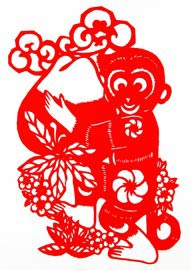
Paper-cut artwork - a monkey holding a peach indicates the longevity of the senior.
Paper-cut is a very distinctive visual art of Chinese handicrafts. It originated from the 6th century when women used to paste golden and silver foil cuttings onto their hair at the temples, and men used them in sacred rituals. Later, they were used during festivals to decorate gates and windows. After hundreds of years' development, now they have become a very popular means of decoration among country folk, especially women.

The main cutting tools are simple: paper and scissors or an engraving knife, but clever and deft craftspeople are remarkably good at cutting in the theme of daily life. When you look at items made in this method carefully, you will be amazed by the true to life expressions of the figure's sentiment and appearance, or portrayal of natural plants and animals' diverse gestures. Patterns of chrysanthemum display the curling petals, pied magpies show their tiny feathers and others such as a married daughter returning to her parents' home, or young people paying a New Year call to their grandparents.


Although other art forms, like painting, can also show similar scenes, paper cutting still stands out for its charm - exacting lines and ingenious patterns which are all hand-made. To make the three-dimensional scenes pop out visually from the paper, as they are usually in monochrome, engravers must exert their imagination. They must delete secondary parts and compose the main body properly, abstractly and boldly. Though simple, the colour then appears charmingly bright.

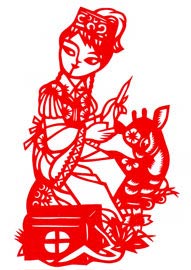
The image of an ethnic minority girl cut with paper It is easy to learn about cutting a piece of paper but very difficult to master it with perfection. One must grasp the knife in an upright fashion and press evenly on the paper with some strength. Flexibility is required but any hesitation or wiggling will lead to imprecision or damage the whole image. Engravers stress the cutting lines in several styles. They attempt to carve a circle like the moon, a straight line like a stem of wheat, a square like a brick, and jaggedly like the beard.

People find hope and comfort in expressing wishes with paper cuttings. For example: for a wedding ceremony, red paper cuttings are a traditional and required decoration on the tea set, the dressing table glass, and on other furniture. A big red paper character 'Xi' (happiness) is a traditional must on the newly wed's door. Upon the birthday party of a senior, the character 'Shou' represents longevity and will add delight to the whole celebration; while a pattern of plump children cuddling fish signifies that every year they will be abundant in wealth.


2011年10月12日星期三

Dongyang Woodcarving Wall Painting: Meeting at the Broken Bridge


A Dating at the Separated Bridge

Best basswood in the north-east of China is applied.  Multi-focus perspective and scattered perspective are combined together in the design and composition, highlighting the main characters, making the background more abundant and stressing a sense of depth. The carving techniques, such as altorelievo, semi-altorelievo, high relief, medium relief and low relief are applied to be superposed relief.

Source: Chinese folk arts on-line gallery

2011年10月11日星期二

Outlaws of the Marsh


Outlaws of the Marsh is one of the Four Famous Classical Chinese Novels. The artist reproduced the 108 heroes in an animated and momentum scene.

For more on Chinese folk arts  on-line gallery